
Dissemination
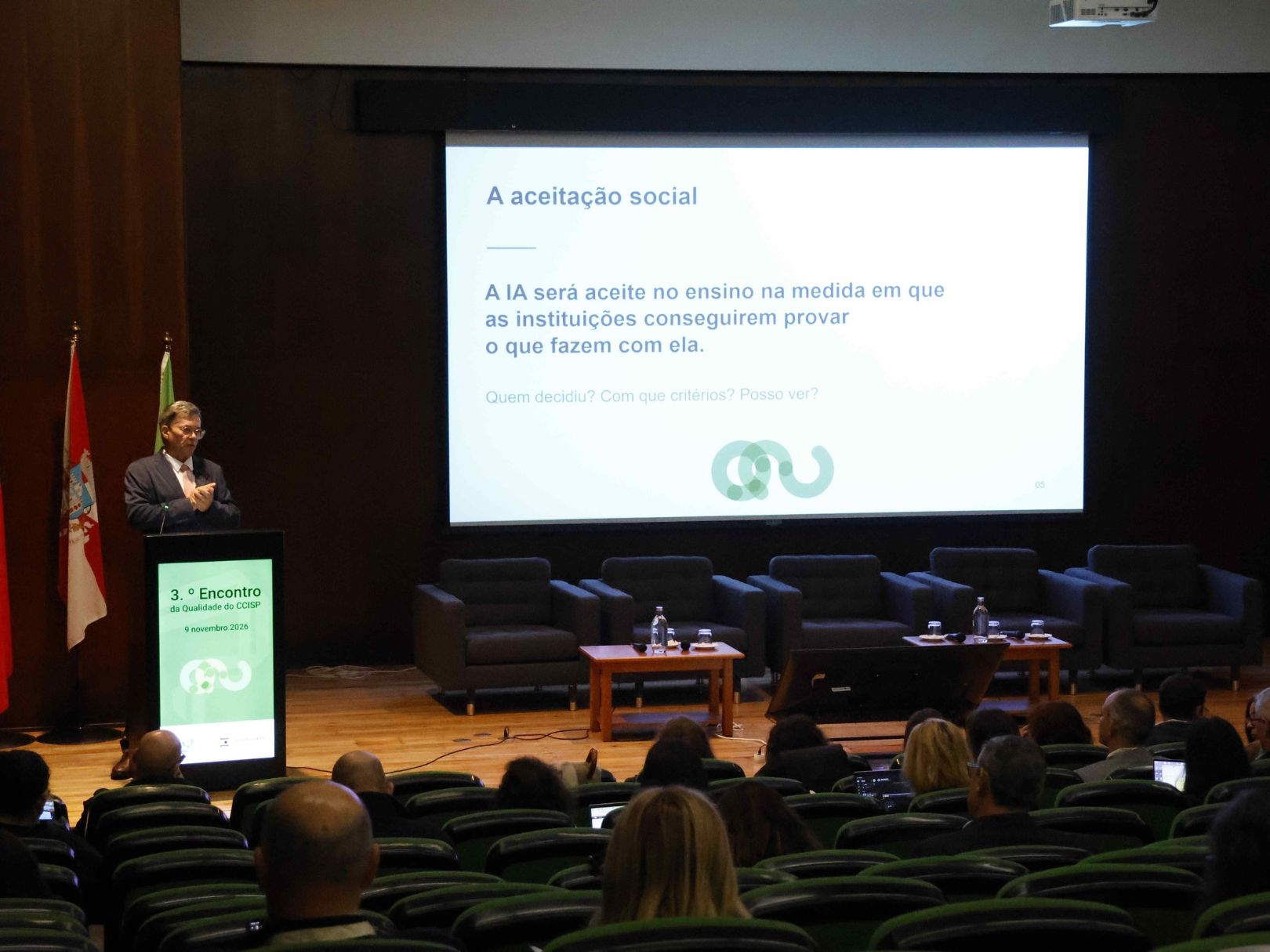
Dario Rodrigues addresses the ethical challenges of artificial intelligence at the 3rd CCISP Quality Meeting
Dario Rodrigues, an integrated researcher at CIAC and lecturer at the Polytechnic University of Santarém, delivered the opening keynote lecture at the 3rd CCISP Quality Meeting (Coordinating Council of Polytechnic Higher Education Institutions), held on 9 November 2026 at the Polytechnic University of Santarém
Under the theme “Quality with AI that Innovates, Sustains and Inspires Trust”, the meeting brought together institutional leaders and heads of quality assurance offices from polytechnic higher education institutions to discuss the role of artificial intelligence (AI) in quality assurance systems.
Entitled “The Ethical Challenges of Using AI: Solving Problems Before They Occur”, the lecture was built around a central idea: quality should be understood as the anticipation and prevention of problems through the design of processes, rather than simply identifying errors after they have occurred.
During his presentation, Dario Rodrigues identified three major ethical challenges associated with the use of artificial intelligence in higher education institutions: the shortcut, opacity and trust.
The first challenge concerns the risk of students, lecturers and researchers using AI tools to produce results without necessarily going through the learning, research or verification processes that should underpin their work. As a response, the researcher advocated placing greater emphasis on assessing processes and demonstrated competencies through oral examinations, observed work, verifiable data and reproducible code.
The second challenge, opacity, relates to the use of AI systems to support or make decisions concerning students, particularly in areas such as predicting student dropout rates and academic success, application screening and monitoring during examinations. In this context, he highlighted the importance of ensuring that the criteria used are verifiable, auditable and open to challenge, while always allowing for human intervention and review.
The third challenge concerns trust. At a time when documents, images and datasets can easily be fabricated or manipulated, institutions need mechanisms to verify the authenticity of information and establish who produced particular content, when it was created and what was actually carried out. Among the solutions highlighted were qualified electronic signatures, electronic timestamps and verifiable digital credentials.
As a practical proposal, the researcher presented four questions that quality assurance offices should ask before adopting any AI tool capable of influencing decisions about individuals: Are the criteria documented and accessible to those being assessed? Do changes to activity records leave an audit trail? Can individuals challenge a decision and request a human review? Will data and decisions remain accessible and verifiable if the system or provider becomes unavailable?
In conclusion, Dario Rodrigues emphasised that AI ethics cannot be addressed solely through declarations of principles or the detection of misconduct after it has occurred. Instead, it must be embedded in the responsible design of processes. He also highlighted that AI agents themselves can contribute to the execution, auditing and verification of procedures, provided that systems are designed to reward and prioritise these functions.
This contribution is connected to the postdoctoral research that Dario Rodrigues is conducting at the University of Algarve, focusing on artificial intelligence and trust infrastructures, under the supervision of Professors Bruno Mendes da Silva and João M. F. Rodrigues.
Esta publicação também está disponível em: Portuguese (Portugal)