CIAC researcher Dario Rodrigues publishes article on Programmable trust for Open Science
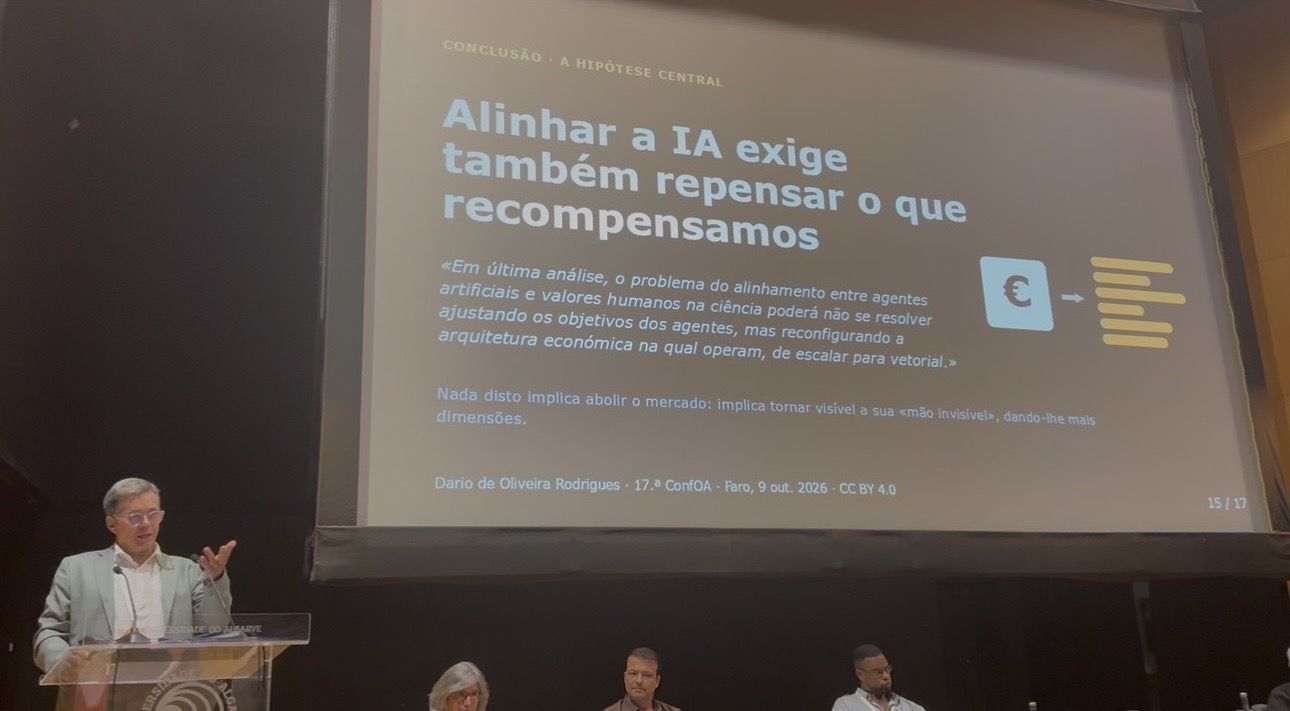
Dario Rodrigues, an integrated researcher at CIAC – Research Centre in Arts and Communication and a professor at the Polytechnic University of Santarém, has published an article entitled Programmable Trust for Open Science: Aligning Human and Artificial Agents through Vectorial Economic Incentives in the Revista Ciência Aberta Lusófona (Vol. 2, 2026). The paper was presented on October 9 during the 17th Lusophone Conference on Open Science (ConfOA), held at the University of Algarve in Faro under the theme Open Science in the Age of Artificial Intelligence.
The article highlights how scientific careers are often evaluated through quantitative indicators, such as citation counts and journal impact factors, while data sharing, research reproducibility, and societal needs receive less recognition. The author argues that artificial intelligence may reinforce this problem by optimising results according to the same indicators.
As an alternative, Dario Rodrigues proposes the concept of Programmable trust, based on the use of shared digital records, similar to blockchain, which can be verified by anyone and cannot be altered unilaterally. This approach seeks to recognise different dimensions of scientific contributions without reducing research evaluation to a single numerical indicator.
The author also draws a parallel with Creative Commons licences, which facilitated content sharing through flexible permissions. Similarly, programmable trust seeks to introduce greater transparency and diversity into the criteria used to recognise scientific contributions. Potential applications of this approach include multidimensional research evaluation, the creation of repositories with verification mechanisms, and the development of institutional policies for more transparent and responsible use of artificial intelligence in science.
The study examines three decentralised science (DeSci) platforms: ResearchHub, VitaDAO, and Codex by DeSci Labs. The analysis shows that while ResearchHub remains subject to the influence of the cryptocurrency market, VitaDAO introduces mechanisms that offer some resistance to this model. Codex, in turn, does not depend on its own cryptocurrency, allowing an approach to knowledge verification and preservation that is less exposed to market dynamics.
This publication represents the first article presented by the researcher as part of his ongoing postdoctoral research at the University of Algarve, focusing on artificial intelligence and trust infrastructures, under the supervision of Professors Bruno Mendes da Silva and João M. F. Rodrigues.
The article is available through open access, together with the reviewers’ reports. The supporting research data are also available in the Zenodo repository.