
Dissemination
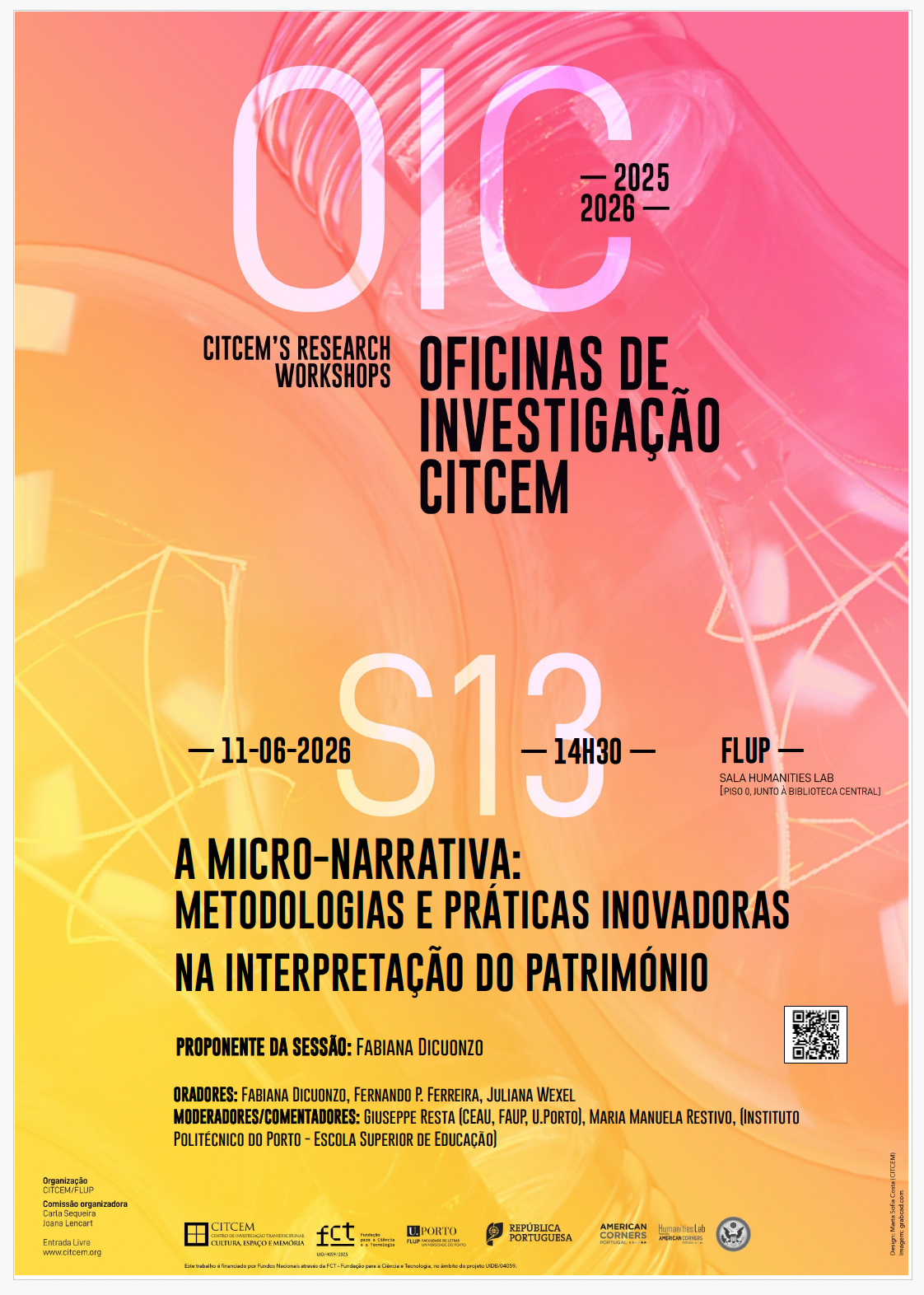
CIAC researcher leads workshop at the Faculty of Arts and Humanities of the University of Porto
Multimedia artist, PhD in Digital Media-Art (UAlg-UAb-DMAD), and CIAC researcher Juliana Wexel will lead the workshop “Micro-Narrative: Methodologies and Innovative Practices in Heritage Interpretation”, promoted by CITCEM – Transdisciplinary Research Centre for Culture, Space and Memory, an R&D unit based at the Faculty of Arts and Humanities of the University of Porto (FLUP). The event will take place on Thursday, June 11, at 2:30 p.m., in the HUMANITIES room at FLUP.
Through her presentation “Who Is Born First: Myth or Poet?”, the researcher will share the creative process behind ARETUSA hydro_VOX (2024), a feminist reinterpretation of the myth of the nymph Arethusa, inspired by the homonymous freshwater spring on the island of Ortigia, Sicily, Italy. The myth is described in Greco-Roman literature, notably in Book V of Ovid’s Metamorphoses.
The video artwork emerged from a performative and nomadic self-writing process rooted in the artist’s experience in Ortigia between 2021 and 2023. It is an autofiction in which the roles of author, narrator, performer, and character intertwine, and where words not only narrate the story but also form the syntax of AI-generated 3D video animations. ARETUSA hydro_VOX is part of a trilogy developed within a practice-based feminist art research project and integrated into the doctoral thesis-creation “Vulva is Media: Vulva Art, Vulvartivism and Digital Media Art.” The work also marks the genesis of the author’s CyberPerformanCity method, which interconnects public space, performative intervention, and cyberspace. The thesis was supervised by Bruno Mendes da Silva and co-supervised by Mirian Tavares.
Juliana Wexel’s research was funded through the Research Grant UI/BD/150845/2021 under Project UIDP/04019/2020, within the framework of the Collaboration Protocol for the Multiannual Research Scholarship Plan for Doctoral Students, established between the Portuguese Foundation for Science and Technology (FCT) and the Research Centre in Arts and Communication (CIAC) of the University of Algarve, Faro, within the Digital Media-Art Doctoral Programme (DMAD).
The workshop “Micro-Narrative: Methodologies and Innovative Practices in Heritage Interpretation” also features PhD candidate Fabiana Dicuonzo (FLUP), presenting “Methodologies for Approaching Everyday Microcosms in the Contemporary Museum”, and Dr. Fernando P. Ferreira (FAUP), who will lead the session “The Factory as Memory: Weaving Affective Stories.” The workshop will be moderated by commentators Dr. Giuseppe Resta (CEAU, FAUP, University of Porto) and Dr. Maria Manuela Restivo (Polytechnic Institute of Porto – School of Education).
The workshop aims to reflect on how micro-narratives can generate interdisciplinary methodologies for the study, analysis, and interpretation of heritage. It explores the concept of micro-narrative through the doctoral projects of three researchers whose disciplinary fields—museology, architecture, and visual arts—are understood not as autonomous and closed domains, but as expanding fields shaped by interdisciplinary methodological dialogue. This approach gives rise to experimental practices focused on the analysis of both tangible and intangible, historical and contemporary heritage through engagement with the micro-voices that constitute its deeper structure.
Adopting art- and practice-based research methodologies, the three projects presented in the workshop propose micro-narrative as a critical interpretative key for understanding society in both its historical and contemporary dimensions, while also imagining possible future scenarios through distinct languages and forms of expression. Inspired by the Augustinian conception of time—articulated through the three presents of memory (past), perception (present), and hope (future)—these investigations embrace a “misaligned” temporality in which past, present, and future are not separate entities but coexist subjectively in a complex and dynamic relationship. In this framework, time becomes a participatory process of reconstructing the meanings of the present.
Through distinct yet convergent approaches, the three research projects seek to develop interpretative tools capable of addressing specific micro-themes as analytical keys applicable to broader issues, restoring to heritage a plurality of voices and meanings that are often marginalized. The session adopts a laboratory format, focusing on the presentation and discussion of research topics, sources, methodologies, and results.
About CITCEM
Founded in 2007, CITCEM – Transdisciplinary Research Centre for Culture, Space and Memory is an R&D unit (No. 4059) based at the Faculty of Arts and Humanities of the University of Porto (FLUP), funded by the Portuguese Foundation for Science and Technology (FCT). The centre brings together researchers from several previous research units.
CITCEM conducts research in the field of Social Sciences and Humanities, promoting a multidimensional approach and awareness. Cooperation with other institutions constitutes a central pillar of CITCEM’s strategic plan, strengthening research networks in an increasingly borderless scientific landscape. CITCEM is the largest R&D Unit at FLUP, with more than 150 integrated members, serving as a dynamic hub for master’s and doctoral students—including 60 FCT scholarship holders—as well as postdoctoral researchers enrolled in FLUP programmes.
For more information, visit: https://citcem.org.
Esta publicação também está disponível em: Portuguese (Portugal)