
Dissemination
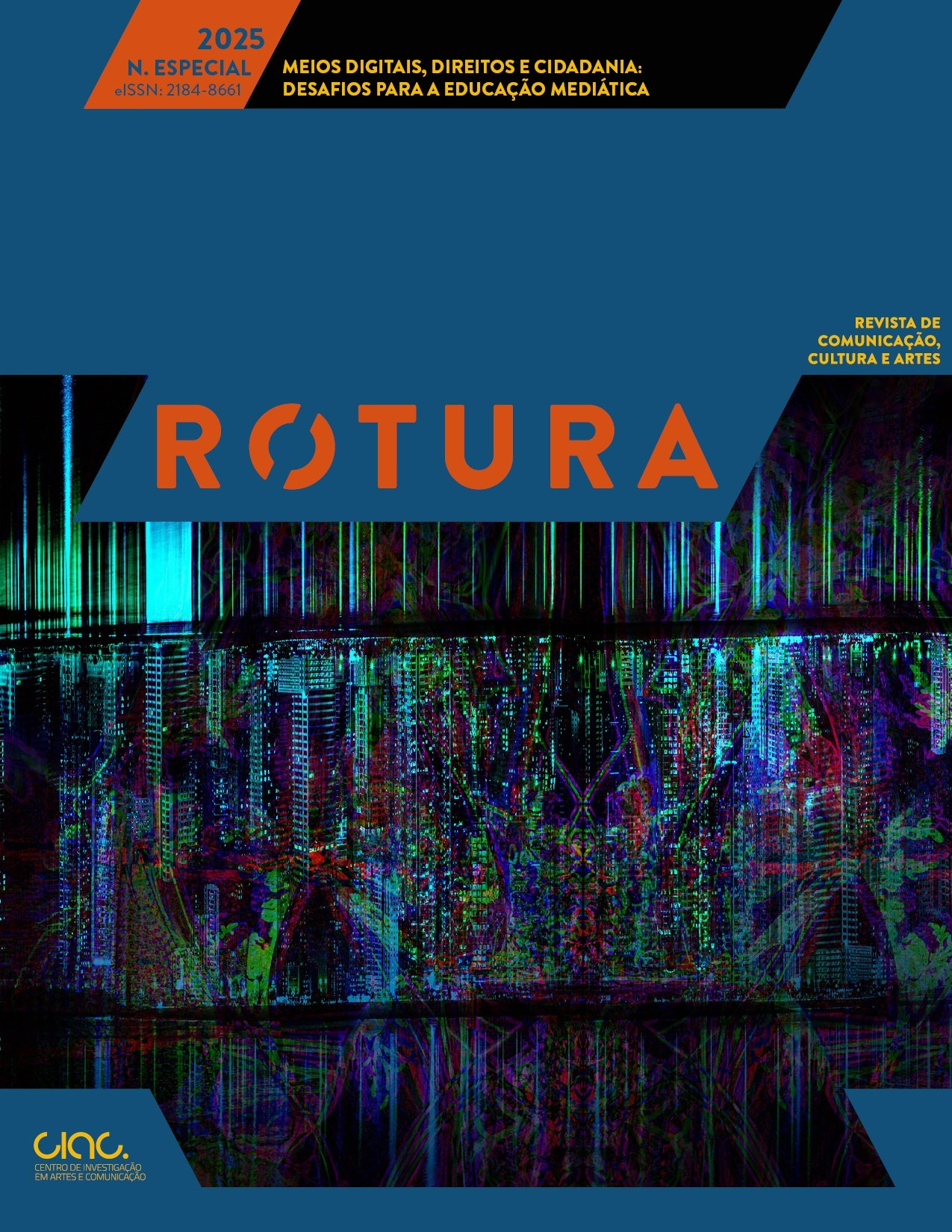
The special issue of ROTURA, focusing on ‘Digital Media, Rights, and Citizenship: Challenges for Media Education,’ is now published and available
The most recent edition of ROTURA – Journal of Communication, Culture, and Arts offers a deep and critical reflection on the challenges and possibilities of media education in the digital age, through the thematic dossier “Digital Media, Rights, and Citizenship: Challenges for Media Education.” This special issue stems from the meeting of Red Alfamed – Euro-American Interuniversity Network on Media Competences for Citizenship, held in San José, Costa Rica, and was guest-edited by Armanda Matos, Paula Renés Arellano, and Ana María Beltrán-Flandoli.
In a context marked by hyperconnectivity, the volatility of information, and the growing presence of digital platforms in everyday life, the articles gathered in this edition explore media education as a critical tool for citizen empowerment, promoting digital literacy, inclusion, and human rights. The issue features contributions from multiple geographic and social contexts, including Portugal, Spain, Brazil, Paraguay, and Peru, offering a multidisciplinary and intercultural approach.
Among the published studies, highlights include:
- The analysis of Peruvian teachers’ perceptions of digital culture;
- A study on freedom of expression among young Portuguese students;
- A systematic literature review on social networks and the inclusion of people with disabilities;
- A bibliometric analysis of gender inequality in educommunication;
- An assessment of young people’s perceived risks in technology use;
- A reflection on the impact of digital capitalism on educational processes.
With this edition, ROTURA stands out for its interdisciplinary approach, fostering dialogue between pedagogical practices, digital languages, and inclusion policies, at a time when it is increasingly urgent to consider education as an emancipatory practice.
New Call for Papers: “Digital Artivism – Intersections of Art, Activism, and Social Transformation”
Simultaneously, a call for papers is open for the next issue of the journal, with the thematic dossier “Digital Artivism – Intersections of Art, Activism, and Social Transformation,” which will be published in February 2026. This edition will be guest-edited by Isabel Cristina Carvalho, Marc Garrett, and Pedro Alves da Veiga.
This new issue invites researchers and creators to explore the convergences between digital artistic practices and forms of political and social intervention. In a media environment shaped by algorithms, surveillance, polarization, and misinformation, digital artivism emerges as an aesthetic and critical practice capable of provoking, mobilizing, and transforming.
Contributions addressing the following topics are especially welcome:
- Genealogies and theories of digital artivism;
- Case studies on online artistic activism;
- Collaborative and participatory practices;
- Artivism as a form of resistance and inclusion;
- Relationships between digital art and the UN Sustainable Development Goals.
Submissions may include research articles, critical essays, case studies, and interdisciplinary proposals, from a perspective that connects art, communication, digital culture, and social transformation.
Important dates:
- Deadline for article submissions: September 15, 2025
- Notification of acceptance: November 15, 2025
- Submission of final version: December 31, 2025
- Publication: February 1, 2026
Call for papers (Chamada de Trabalhos | Rotura – Revista de Comunicação, Cultura e Artes).
ROTURA Journal(n. Especial (2025): Meios digitais, direitos e cidadania: desafios para a educação mediática | Rotura – Revista de Comunicação, Cultura e Artes).
Esta publicação também está disponível em: Portuguese (Portugal)