
Dissemination
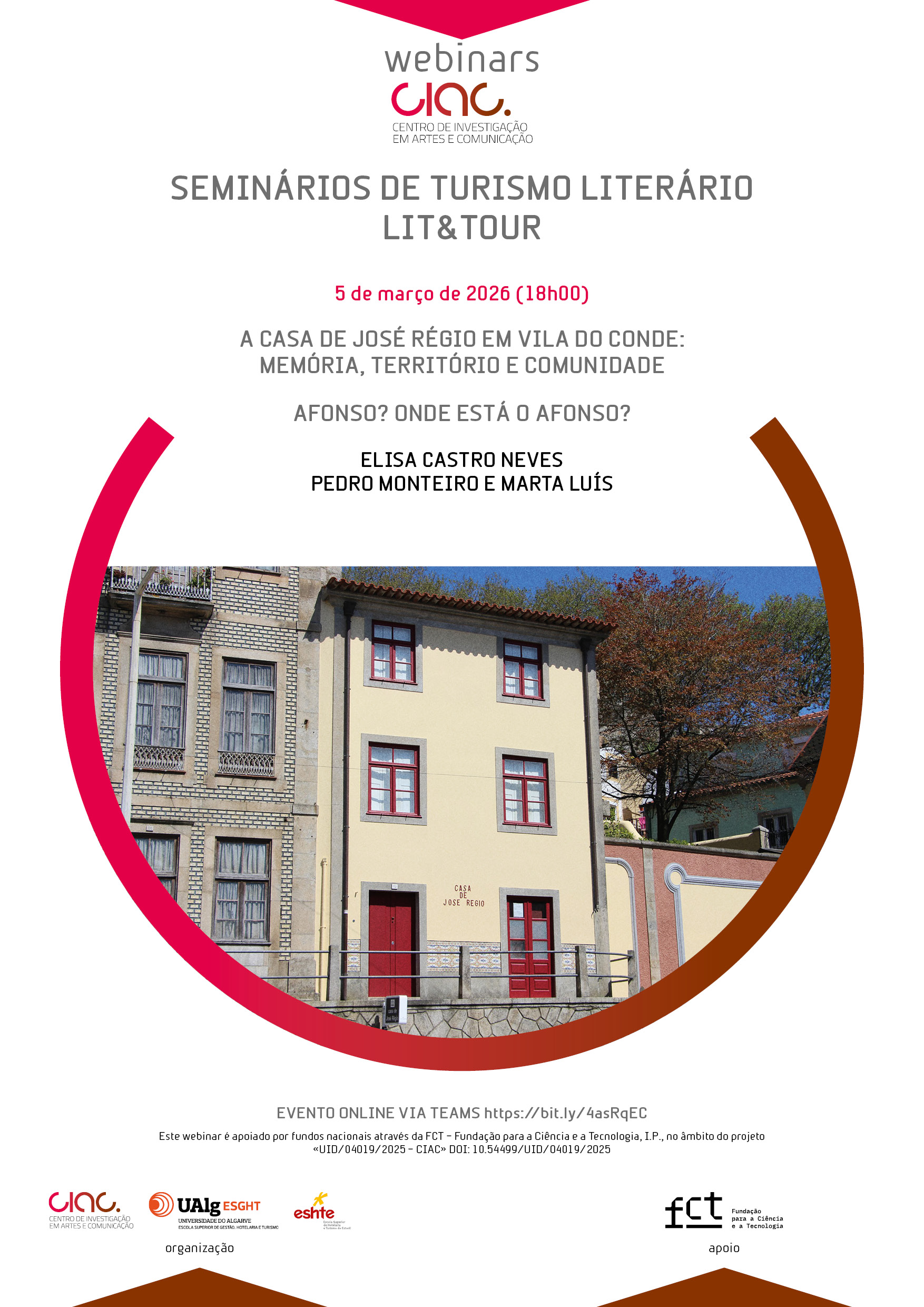
Literary Tourism Webinar will explore the literary places associated with José Régio and Afonso Lopes Vieira
The Literary Tourism Webinar, taking place on March 5, 2026, will explore the literary places associated with José Régio and Afonso Lopes Vieira.
Guest speaker Elisa Castro Neves will present “The House of José Régio in Vila do Conde: Memory, Territory and Community.” José Régio (1901–1969), born in Vila do Conde, was a Portuguese writer, poet, playwright, novelist, short story writer, essayist, chronicler, literary critic, and literary historian, as well as a painter and a renowned connoisseur and collector of sacred and folk art.
After his death, the poet’s house was acquired by the Vila do Conde City Council, converted into a museum space, and opened to the public on September 17, 1975. The museum includes a collection of furniture, sacred art, ceramics, and paintings gathered by the writer throughout his life, as well as his manuscripts. As guardian of the memory of the man, the artist, and his work, the House reveals how a domestic space can be transformed into a place of literary interpretation and contemporary dialogue between territory and community.
Next, Pedro Monteiro and Marta Luís, with the presentation “Afonso? Where Is Afonso?”, propose an analytical challenge focused on a literary place that led to the discovery of multiple spaces and facets of Afonso Lopes Vieira (1878–1946), a Portuguese poet, essayist, novelist, and author of children’s books, born in Leiria and creator of an extensive body of literary work.
CIAC invites the academic community and all those interested in the relationship between literature, territory, and memory to reflect on two exemplary cases of Portuguese heritage. The event will take place online at 6:00 pm via the Teams platform, in a session available through the provided link.
The Literary Tourism Webinar is supported by national funds through the FCT – Fundação para a Ciência e a Tecnologia, under the project «UID/04019/2025 – CIAC» DOI: 10.54499/UID/04019/2025.
Esta publicação também está disponível em: Portuguese (Portugal)