
Dissemination
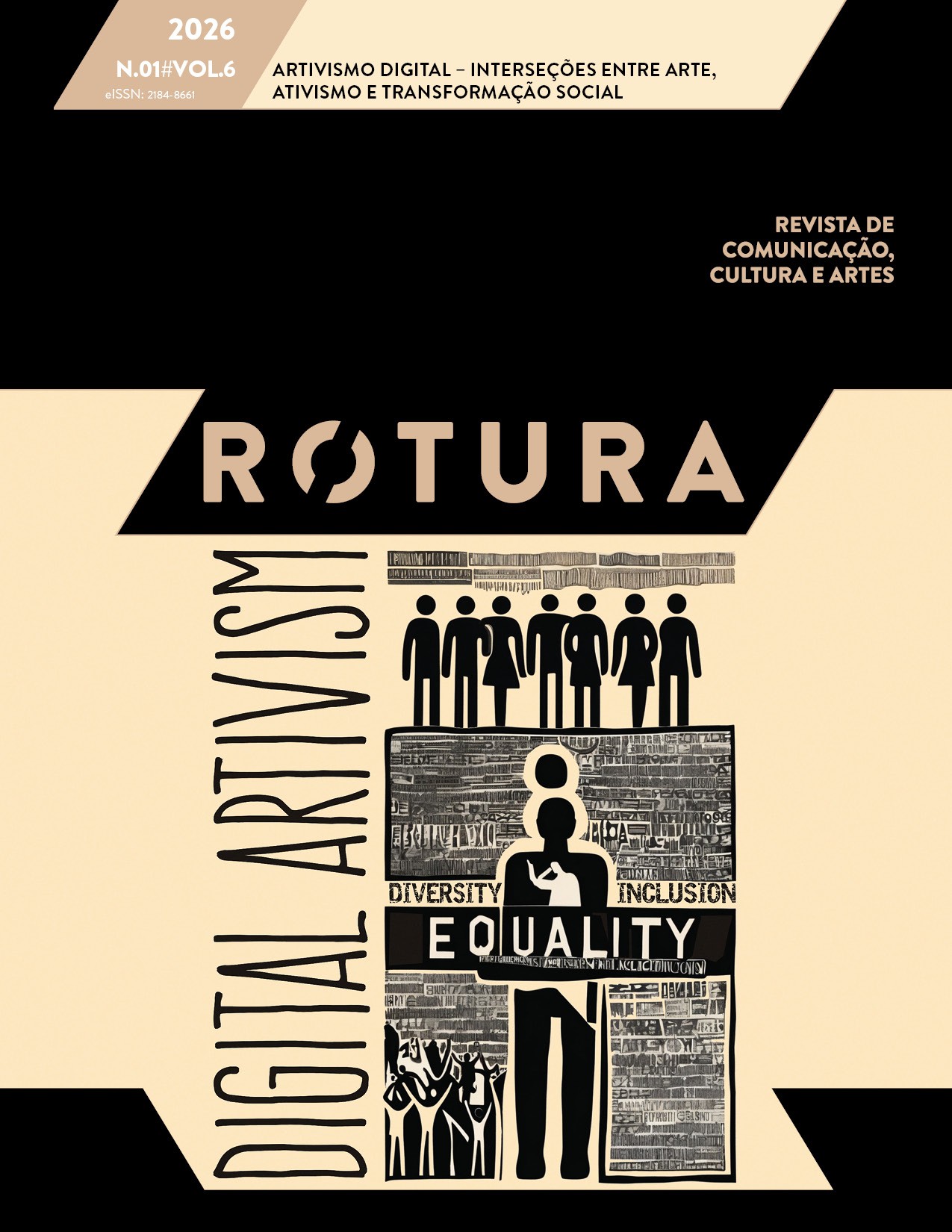
New issue of ROTURA Journal published on Digital Artivism
The Vol. 6, No. 1 (2026) of ROTURA – Journal of Communication, Culture and Arts has been published, dedicated to the theme “Digital Artivism – Intersections between Art, Activism, and Social Transformation.” It is now available for consultation and download on the journal’s platform.
In a context marked by digital saturation, the ubiquity of platforms, and the central role of algorithmic systems in organizing social life, Digital Artivism emerges as a form of insurgency that is simultaneously poetic, aesthetic, and political. Rather than positioning itself outside the systems it critiques, it operates from within them—exploring their fissures, exposing their contradictions, and reconfiguring regimes of visibility, participation, and symbolic circulation.
The articles gathered in this issue reflect this condition of critical ambivalence, exploring practices ranging from remix culture, subvertising, and tactical media to hacktivism, generative art, immersive narratives, and independent video games. What these approaches share is not an attempt to eliminate the algorithm or abandon the platform, but to inhabit them critically—introducing friction into information flows and creating spaces of interruption, dissonance, and reflection.
Throughout the volume, Digital Artivism is addressed as a practice of critical cartography of digital infrastructures, making visible the invisible logics of datafication, surveillance, and data extraction. At the same time, its territorial and community dimensions are highlighted through the production of counter-narratives, counter-mappings, and spaces of expression for marginalized voices—where the digital reinscribes, rather than erases, social and political space.
This issue also emphasizes the pedagogical and participatory dimensions of these practices, underscoring their potential to promote critical literacy, civic engagement, and co-creation.
Topics covered include:
- Histories and genealogies of digital artivism
- Theoretical and conceptual frameworks
- Critical pedagogies and inclusive forms of digital art
- Digital artivism and community co-construction
- Digital artivism and the UN 2030 Agenda for Sustainable Development
- Methodologies of practice and participation
- Between political art and activist art
The full volume can be found on the journal’s website.
Esta publicação também está disponível em: Portuguese (Portugal)