
Dissemination
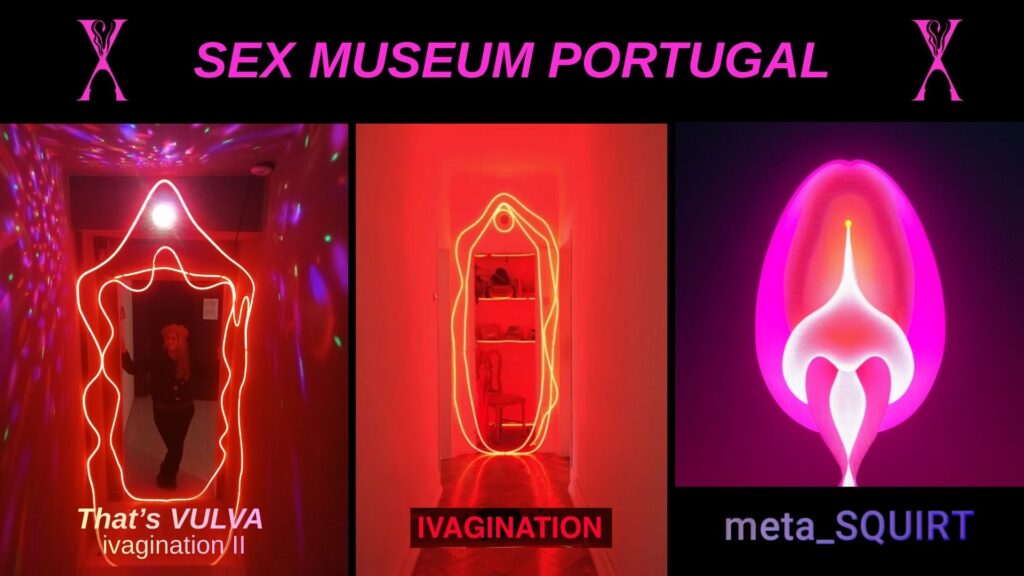
CIAC researcher Juli Wexel collaborates with three vulva art and digital media art installations for the Sex Museum Portugal
By invitation of Sex Museum Portugal, in Porto, multimedia artist, PhD in Digital Media Art (UAlg–UAb DMAD), and CIAC researcher Juli Wexel created That’s VULVA: ivagination II (2026) in May 2026, an exclusive, permanent, site-specific installation for the museum. In July, the Sex Museum also inaugurated two additional permanent audiovisual installations by the artist: shortdoc ivagination (2020) and the video art work meta_SQUIRT (2023–2026).
That’s VULVA: ivagination II (2026) is an interactive adaptation of the artist’s original ephemeral computational “de-installation” ivagination (Lisbon, 2020), created at her residence in Lisbon. In both works, the clitoris is activated by the movement of visitors as a tribute to the organ’s unique function of generating pleasure. That’s VULVA: ivagination II is the fourth feminist media art artefact in the career of the Italian-Brazilian artist, whose work combines speculative practice-based artistic research with the development of her doctoral theory on the global vulva art movement.
Within the current fourth wave of feminism (2012–), artists associated with vulva art focus on the female genitalia as an object of visual, performative, symbolic, and narrative representation, using aesthetic discourses to deconstruct patriarchal notions and taboos surrounding binary and non-binary subjectivities, vulvar anatomy, pleasure, eroticism, orgasm, masturbation, menstruation, and reproduction through intersectional vulvar and clitoral iconographies embracing cisgender, transgender, and intersex bodies. In her doctoral dissertation VULVA IS MEDIA: Vulva Art, Vulvartivism and Digital Media Art (2025), Juli Wexel introduces the original concepts of vulvartivism—vulva artivism, a branch of insurgent and socially engaged art celebrating themes such as vulvar diversity—and clitartivism, a category of vulvartivism centred on the clitoris as the subject of representation in clitoris art or clit art. The dissertation was supervised by Professor Bruno Mendes da Silva, Coordinator of CIAC, and co-supervised by Professor Mirian Tavares, the Centre’s Vice-Coordinator.
The installation of short doc ivagination (2020) was curated alongside That’s VULVA: ivagination II (2026) at the Sex Museum. Sharing the same title as the original de-installation ivagination (2020), short doc ivagination is a spin-off or derivative artwork documenting its creative process while actively, systematically, and visually communicating the concept behind the original vulva art experience. In a society where female genitalia are simultaneously desired and revered, yet also disrespected, objectified, oppressed, violated, and mutilated, ivagination becomes a space for celebration and interaction free from taboos.
In the audiovisual work, Juli Wexel reflects on the central theme of the project and reveals the deeply personal experiences that inspired her desire to portray female genitalia in a sensory manner. The creation of ivagination marked the beginning of the artist’s artistic-academic research into the vulva art movement.
The ivagination (2020) de-installation formed part of the exhibition Re>>connecting, presented during ONLINE 2020 at the 8th Doctoral Retreat in Digital Media Art (DMAD) of the University of Algarve in collaboration with Universidade Aberta (UAlg–UAb). The exhibition was collectively curated by nine creatives who developed computational artefacts from Brazil, Portugal, Mozambique, Indonesia, and China. The documentary therefore records the audience’s experience during the Off Re>>connecting opening on 4 July 2020.
The computational de-installation ivagination also served as the set for the original theatrical work Esperando Godette, selected and funded by the 2020 Mimesis Theatre and Performing Arts Cycle, organised by the Rectorate of the University of Coimbra between 15 September and 2 October 2020. The online performance was later presented at the Fair Saturday Festival from 28 November to 31 December 2020 in support of ASAS – Academia Sénior para Idosos (ANGES), Lisbon.
short doc ivagination (6’16”, 16:9) was produced over three days of filming, including behind-the-scenes footage documenting the installation process. It was developed collaboratively with the Lisbon-based production company Plata o Plomo Duo (now Tartarugas e Crocodilos), featuring cinematography by Maurício Franco, editing and sound design by Filipe Traslatti de Mello, and production by Carine Panigaz.
The documentary remains an important vulvartivist communication tool, extending the public experience beyond the ephemerality of the original physical installation. It was screened on 20 March 2026 during the Vivas nos queremos event organised by Levante Cultural Produções at the Alcântara Library in Lisbon, and had previously premiered in situ within the exhibition space of the ARTeFACTo 2020 International Conference on Digital Creation in Arts and Communication at the University of Algarve. The audiovisual work ivagination (2020) is also available on the scientific-artistic platform of the Climacom-LabJor Journal of the University of Campinas (UNICAMP, Brazil) on YouTube: https://www.youtube.com/watch?v=sZPR0t1C0E4.
In the video artwork meta_SQUIRT (2023–2026), Juli Wexel evokes the cyberfeminist atmosphere of the 1990s together with a vibrant neon aesthetic in a visual narrative that constructs an anatomical, poetic, and non-pornographic vulvar iconography. The work subverts patriarchal sexual culture by elevating female pleasure and ejaculation to the status of an aesthetic and political manifesto.
This exclusive version for the Sex Museum challenges both the physical and conceptual boundaries of contemporary digital art. The installation consists of 3D video animations created through metacreativity, combining human intentionality with Generative Artificial Intelligence. The deep learning algorithm functions as an alchemical engine, operating metaphor and metamorphosis within its own computational syntax. Web 3.0 generative technology is employed critically—not merely as a tool, but as a co-creative entity—in order to deconstruct gender stereotypes.
Native elements from the mythical Fountain of Arethusa in Ortigia (Sicily, Italy) continuously and fluidly transform into sexual metaphors and the morphology of the female genitalia, generating a vulva art discourse. The historic papyrus (Cyperus papyrus) becomes a “Cyperus-vulva,” while the anatomy of the clitoris—the most significant structure for pleasure in bodies with vulvas—gradually reveals itself through imagery inspired by the ducks inhabiting the Italian mythological fountain. The uninterrupted transformation of these figures—such as the clitoral silhouette echoing migratory birds—creates an original visual metalanguage.
Within this continuous flow, the fluid mechanics of squirt or squirting (female ejaculation) are poetically associated with Archimedes’ principle of buoyancy and represented precisely at the point where the freshwater of the Fountain of Arethusa meets the saltwater of the sea, equating the water of female pleasure with the very water of life.
meta_SQUIRT (7’39”, 1:1) is a speculative experiment in Feminist Research in Digital Media Art inspired by the artist’s nomadic experience living on the island of Ortigia between 2022 and 2023. At its core, the work reclaims the body as sovereign territory, where the ancient Greco-Roman myth of the nymph Arethusa converges with a cybernetic future to celebrate the absolute sovereignty of female desire. The incidental soundtrack for meta_SQUIRT was produced in collaboration with Mad Lab Sound Studio (Vila Nova de Gaia, Portugal).
That’s VULVA: ivagination II (2026), short doc ivagination (2020), and meta_SQUIRT (2023–2026) align with the indicators of United Nations Agenda 2030 Sustainable Development Goal 5, promoting gender equality through equitable access to technology and information while contributing to the fight against sexual violence, including Female Genital Mutilation (FGM).
The three installations have been donated by the artist to Sex Museum Portugal as a gesture of gratitude to the Portuguese Republic for the financial support received through the doctoral research grant UI/BD/150845/2021, funded under Project UIDP/04019/2020, within the Collaboration Protocol for the Multiannual Research Scholarship Programme for Doctoral Students, established between the Portuguese Foundation for Science and Technology (FCT) and the CIAC – Research Centre for Arts and Communication at the University of Algarve, in Faro, within the framework of the PhD Programme in Digital Media Art (DMAD), in cooperation with Universidade Aberta, Lisbon.
Sex Museum Portugal is open daily from 10:00 a.m. to 7:00 p.m. Further information is available at sexmuseumportugal.com.
Esta publicação também está disponível em: Portuguese (Portugal)