
Dissemination
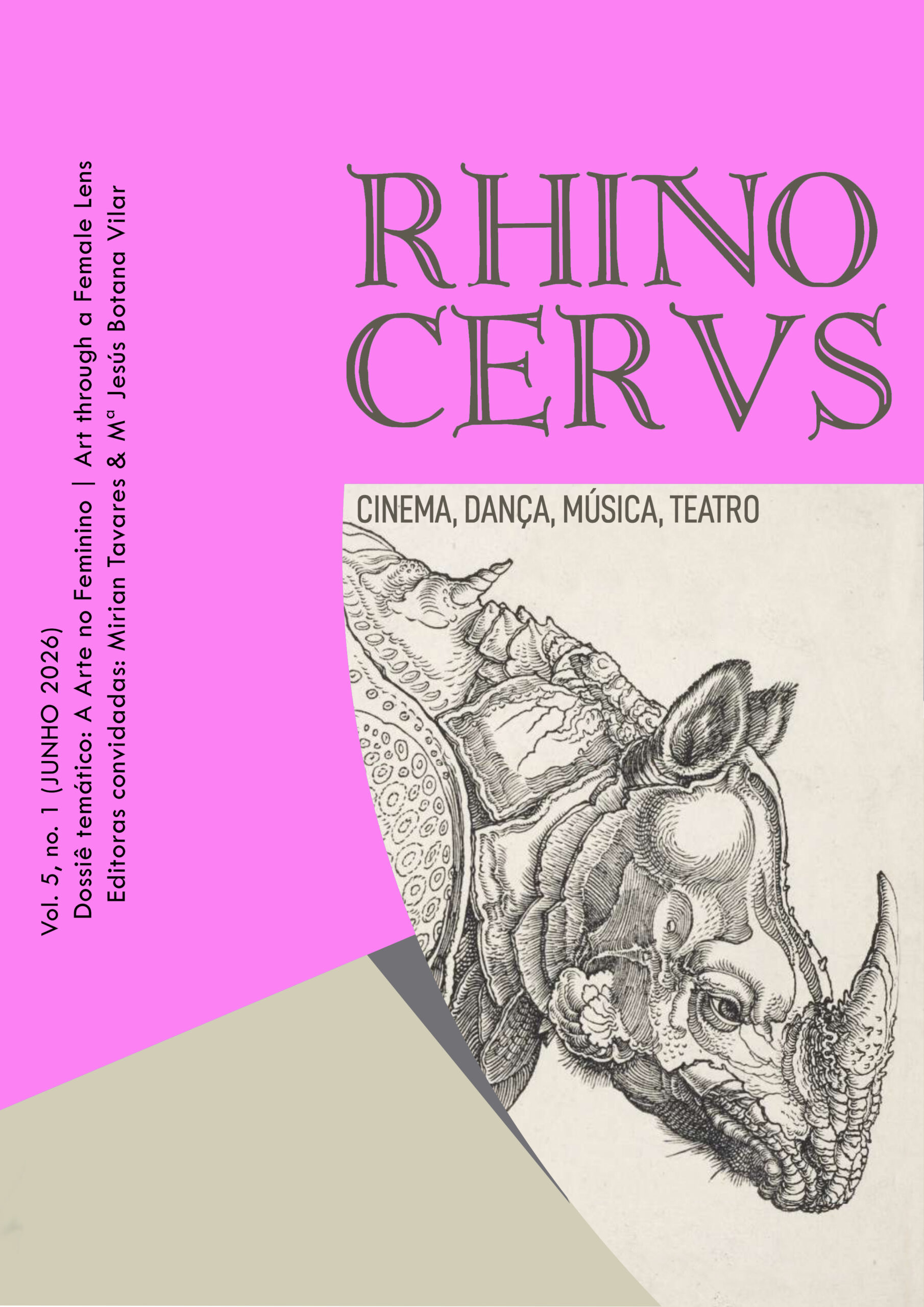
New issue of Rhinocervs journal features CIAC researchers as guest editors
Mirian Tavares, Vice-Coordinator of CIAC, and Maria Jesús Botana Vilar, CIAC researcher, are the guest editors of the latest issue of the journal Rhinocervs – Cinema, Dance, Music, Theatre (Vol. 3, No. 1, 2026).
Entitled “Women in Art – A Fragmented History”, this special issue is grounded in the recognition that art history has long been constructed through narratives that marginalized or rendered women’s artistic production invisible. Although recent decades have witnessed growing recognition of women artists and the expansion of feminist studies in the arts, inequalities persist in processes of legitimation, representation, and cultural memory-making. The articles gathered in this issue offer a critical reassessment of these narratives by recovering forgotten trajectories, reinterpreting archives, questioning regimes of visibility, and exploring contemporary artistic practices that challenge established hierarchies. Drawing on diverse geographical, temporal, and disciplinary contexts, the contributions address themes such as cinema, memory, exile, performance, digital media art, artivism, and artificial intelligence, highlighting the role of women in artistic production and in the construction of alternative forms of knowledge.
In addition to the guest editors, several other CIAC researchers contributed to the volume. In the article “Discovering Marie Isabelle Canto da Maya: Archive, Absence, Presence”, Ana Isabel Soares proposes a historiographical revisitation of Portuguese cinema through the figure of Marie Isabelle Canto da Maya, a filmmaker, photographer, actress, and writer whose work remains largely unknown.
The notion of artistic practice as a form of critical knowledge production runs through Juliana Wexel’s article, “CyberPerformanCity: An Experimental Methodological Resource for Creative Processes in Digital Media Art, Performing Arts and Urban Space”. The article highlights the potential of authorial methodologies for contemporary artistic creation, integrating a feminist, technological, and performative perspective on the occupation of physical and digital spaces.
In “Feminist Representations in Digital Art: Beatriz Albuquerque and Mónica de Miranda”, Ana Gavina analyses the work of these Portuguese artists, reflecting on how feminist digital art practices challenge regimes of visibility, authorship, and legitimation.
Finally, the project in/visibilities in the feminine, by Célia Palma and Isabel Carvalho, explores the relationship between digital media art, artivism, and Generative Artificial Intelligence, proposing artistic practice as a space for the symbolic reinscription of historically marginalized female memories and narratives.
The issue also includes the article “‘La piba que tocaba’: Woman, Art and Spanish Republican Exile in Argentina” by Mariela Sánchez, researcher at the Universidad Nacional de La Plata and CONICET, which recovers the forgotten trajectories of the Spanish artist María Victoria Iniesta. In addition, Giovanna de Campos, in “The Essay Film as Poetic Thought: A Study of Las Poetas visitan a Juana Bignozzi”, shifts the historical discussion to the field of essay cinema, analysing the Argentine film Las poetas visitan a Juana Bignozzi (directed by Laura Cittarela and Mercedes Halfon, premiered in 2019).
The complete issue of the journal is available [here].
Esta publicação também está disponível em: Portuguese (Portugal)