
Dissemination
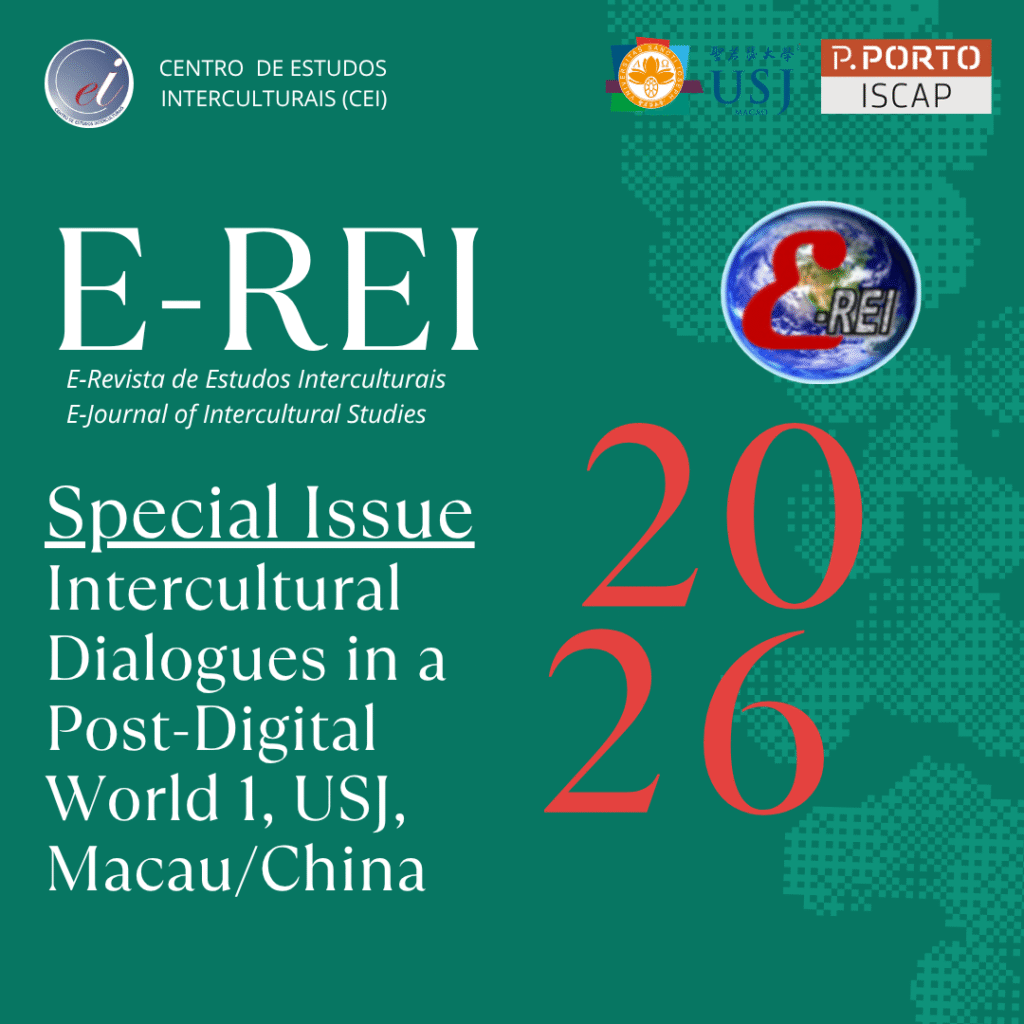
Special issue of E-REI highlights CIAC members’ research on intercultural communication
The scientific journal E-REI – E-Journal of Intercultural Studies has published its 2026 special issue, entitled Intercultural Dialogues in a Post-Digital World 1. Published in the context of the University of Saint Joseph in Macau, this issue brings together studies dedicated to the transformations of intercultural communication in a society deeply shaped by digital platforms, the transnational circulation of content and new forms of interaction between different communities. The articles address contemporary issues related to human mobility, cultural identities, technological mediation and participation in digital spaces, contributing to a critical understanding of the communicational challenges of the post-digital world.
Among the published works, the article “Desafios e perspetivas críticas na comunicação intercultural entre Brasil e Portugal: um estudo de caso sobre o meme da Guiana Brasileira” (Critical challenges and perspectives in intercultural communication between Brazil and Portugal: a case study on the Brazilian Guiana meme), authored by Valdemir Santos Neto and Professor Gabriela Borges, both members of CIAC, stands out. The study analyses the circulation and repercussions of the “Guiana Brasileira” meme on social media, examining how an expression initially used satirically by Brazilian users began to generate reactions, symbolic disputes and identity tensions among Brazilian and Portuguese audiences. The research adopts a qualitative approach based on a case study that combines empirical, statistical and documentary data, considering both the role of digital influencers as cultural mediators and the horizontal interactions established within online communities.
Based on this phenomenon, the researchers discuss the ethical, cultural and communicational challenges associated with the production of content about immigration and intercultural relations between Brazil and Portugal. The article demonstrates that the algorithmic logics of platforms, driven by visibility and engagement, can favour simplified interpretations, polarised discourses and conflicts that extend beyond digital spaces. The authors argue for the need to integrate intercultural, critical, linguistic and media competences into the training of communicators and content producers.
Read the full article and the different contributions included in this special issue of E-REI (here).
Esta publicação também está disponível em: Portuguese (Portugal)